The Brutal Truth About How Hard Is Learning Guitar

how hard is learning guitar
Table of Contents
The answer to how hard is learning guitar depends entirely on the expectations you bring to the fret board. For most beginners, the initial climb is steep and humbling. It’s a physical, mental, and rhythmic challenge unlike any other hobby. Your fingers will hurt, chords will sound muddy, and simple songs feel impossibly fast. This isn’t meant to discourage you—it’s to frame the reality. The difficulty is a feature, not a bug. The immense satisfaction comes from conquering specific, tangible barriers over time.
Understanding this upfront separates those who quit in frustration from those who build a lifelong skill. The journey from awkward strums to fluid musical expression is a series of plateaus and breakthroughs. Your progress is less like a straight line and more like a staircase. You’ll grind on a single skill for weeks with no apparent improvement, then suddenly something clicks and you leap to the next level.
The Three Core Pillars of Guitar Difficulty
Breaking down how hard is learning guitar into its components makes the challenge manageable. The struggle isn’t monolithic; it’s a combination of distinct skill sets you must develop simultaneously.
1. The Physical Hurdle: Building Calluses and Muscle Memory
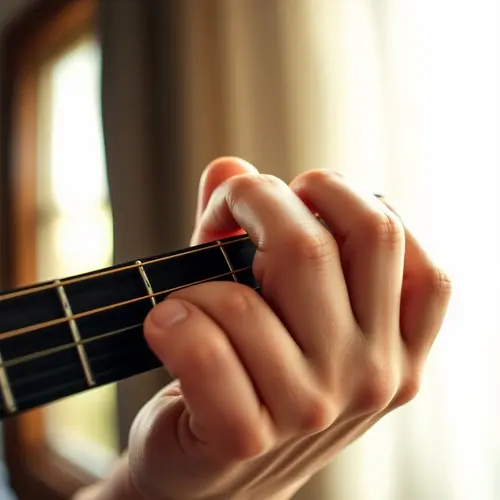
Your first tangible barrier is physical. Pressing steel strings against a wooden fretboard requires force. For the first few weeks, your fingertips will be tender, even painful. This isn’t optional suffering; it’s the process of building protective calluses. A study on fine motor skill acquisition from the National Institutes of Health highlights the neural adaptation required for repetitive, precise movements. Each time you form a G chord, you’re forging new neural pathways. The clumsiness you feel today is the precursor to the unconscious fluency you’ll have in a few months.
Hand independence is another major physical challenge. Your fret hand must contort into precise shapes, while your strumming or picking hand maintains a steady rhythm. It feels like patting your head and rubbing your stomach, but with more consequences for getting it wrong. This coordination is non-negotiable for playing anything beyond the simplest melodies.
2. The Mental Load: Theory, Fretboard Logic, and Ear Training
Once your fingers start to obey, the mental game begins. The fretboard is a grid of notes that can seem random. Learning basic music theory—scales, chord construction, and key signatures—provides the map. According to principles outlined in academic journals on music cognition, understanding the “why” behind chord progressions significantly accelerates skill acquisition compared to rote memorization.
You’re not just memorizing shapes. You’re learning a language. Ear training, the ability to recognize intervals and chords by sound, is a parallel skill that often feels elusive. It’s what allows you to learn songs by listening, a skill that separates hobbyists from true musicians. This cognitive layer adds depth to the physical act of playing.
3. The Rhythm and Timing Barrier
This is the most common stumbling block that beginners underestimate. You can nail every note in a scale, but if your timing is off, it won’t sound like music. Internalizing a steady pulse and executing rhythmic strumming patterns is a foundational skill. Many players focus solely on their fretting hand, only to realize their rhythm hand is what’s holding them back. Using a metronome isn’t a beginner’s crutch; it’s the tool professionals use to stay honest. The difficulty here is subdividing beats while coordinating both hands, a core tenet of musical proficiency.
| Skill Area | Initial Difficulty (1-10) | Time to Basic Competence | Critical Success Factor |
|---|---|---|---|
| Chord Changes | 8 | 2-3 months | Deliberate, slow practice with a metronome |
| Strumming Patterns | 7 | 1-2 months | Isolating the right hand; starting without chords |
| Fretboard Navigation | 9 | 6+ months | Learning scales in one position, not just memorizing notes |
| Playing by Ear | 10 | 1+ years | Daily interval training; simple song transcription |
A Realistic Timeline: What “Progress” Actually Looks Like
Discarding unrealistic timelines is key to managing frustration. The question of how hard is learning guitar is often a question of “how long.” Progress is non-linear.
- First Month: Painful fingertips. Mastering 4-5 open chords (G, C, D, Em, Am). Slow, deliberate changes between them. Simple one-string melodies. The sense that it’s harder than you imagined.
- Months 2-4: Calluses form. Chord changes become faster, less conscious. Introduction of basic strumming patterns and the F chord (the first major hurdle). Ability to play simple, whole-song chord progressions.
- Months 5-8: Rhythmic competence improves. Barre chords begin to sound clear. You learn pentatonic scale shapes and can improvise simple licks. You start to recognize chord progressions in songs you hear.
- Year 1+: Technique and theory start to merge. You understand why the chords in a song work together. You can learn songs by ear more quickly. The instrument begins to feel like an extension of your expression, not a puzzle to solve.
Expert Perspective: Debunking the “Natural Talent” Myth
A pervasive myth that exacerbates the perceived difficulty is the idea of innate talent. The consensus among seasoned instructors and performance psychologists is that “talent” is largely a mirage. What observers label as talent is almost always the product of quality practice. The struggling beginner and the fluid player are separated by hundreds of hours of focused, intentional repetition.
Consider a common scenario: a student can play a riff perfectly slowly but falls apart at full speed. The instinct is to repeat the failure, hoping for a different outcome. The expert approach is diagnostic. Is the failure in the fret hand’s preparation? Is the pick hand’s motion inefficient? Breaking the phrase into two-note fragments, mastering each link with a metronome, then reassembling it—this is the unsexy work that creates fluency. The difficulty isn’t in lacking talent; it’s in lacking a structured method to address specific weaknesses.
Optimizing How Hard Is Learning Guitar to Reduce the Struggle
You can’t eliminate the inherent challenge, but you can engineer your path to be more efficient. Your practice strategy dictates how hard is learning guitar for you.
- Focus on Fundamentals, Not Songs: Dedicate 80% of your practice to core skills (scales, chord changes, rhythm drills) and 20% to applying them in songs. This builds transferable ability.
- Use a Metronome from Day One: Timing is a fundamental, not an advanced skill. Start painfully slow. Speed is a byproduct of accuracy.
- Record Yourself: Your perception while playing is often flawed. Listening back provides brutal, objective feedback on timing and clarity.
- Seek Specific Feedback: “This sounds bad” is useless. “My transition from C to G muffles the B string” is a solvable problem.
The final truth about how hard is learning guitar is that it’s a deliberate choice. You choose to engage with the frustration of slow progress. You choose to practice deliberately when mindless strumming is more comfortable. The hardness is the price of admission for a skill that offers a unique form of creative expression, cognitive engagement, and personal reward. The initial barrier is high, but the gate only swings one way. Once you’re through, the landscape of music opens up, and the struggle becomes the most rewarding part of the journey.

Sherina Arabella is a senior music education specialist at DB Music Academy covering guitar, vocals, and learning psychology. 6+ years, 120+ guides. Method: conservatory methodology and motor-learning research. Author of 2,082 music guides since 2022.