Master Guitar Basics: Essential Guide for Beginners
learn guitar basics
Table of Contents
If you want to learn guitar basics, start by understanding the instrument’s anatomy, proper posture, and three fundamental open chords. Most beginners fail because they skip foundational techniques and rush into complex songs.
The guitar has six strings tuned to E-A-D-G-B-E from thickest to thinnest. Each string produces different pitches when pressed against metal frets along the neck.
Your fretting hand controls notes while your strumming hand creates rhythm. This coordination forms the core of guitar playing.
Why Learn Guitar Basics Before Advanced Techniques
According to research from the National Association for Music Education, students who master foundational skills progress 3x faster than those who skip basics. Building proper muscle memory early prevents years of correcting bad habits.
Many online tutorials push beginners toward complex finger picking patterns too soon. This approach creates frustration and high dropout rates.
Professional instructors recommend spending at least 30 hours on fundamentals before attempting intermediate material.
Essential Equipment for Getting Started
You need only three items to begin: an acoustic or electric guitar, a tuner, and picks. Avoid expensive gear initially.
Acoustic guitars work without amplification, making them ideal for practice anywhere. Electric guitars require an amplifier but offer easier playability due to thinner strings and lower action.
Digital tuners cost under $15 and ensure your strings produce correct pitches. Playing an out-of-tune guitar trains your ear incorrectly and slows progress.
Proper Sitting Posture and Hand Position
Sit upright with the guitar’s waist resting on your dominant leg. The neck should angle upward at approximately 45 degrees.
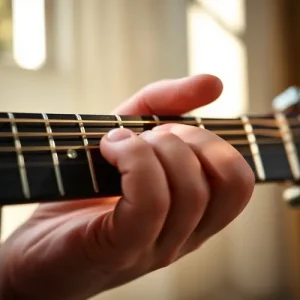
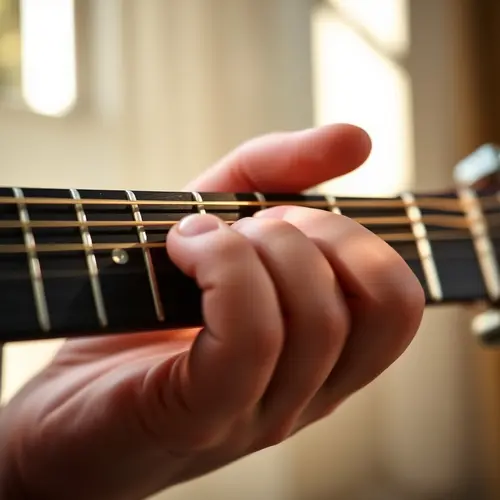
Keep your fretting hand’s thumb behind the neck, not gripping over the top. This position allows fingers to press strings cleanly without muting adjacent strings.
Your strumming hand should hover over the soundhole (acoustic) or pickups (electric) with a relaxed wrist. Tension in either hand causes fatigue and limits speed development.
Three Chords Every Beginner Must Learn Guitar Basics
Start with E minor, A minor, and G major. These open chords appear in thousands of popular songs and require minimal finger stretching.
E minor uses only two fingers on the second fret. Place your middle finger on the A string and ring finger on the D string, then strum all six strings.
A minor adds your index finger to the first fret of the B string while middle finger presses the D string’s second fret and ring finger holds the G string’s second fret. Strum only the bottom five strings.
| Chord Name | Fingers Used | Strings Played | Difficulty Level |
|---|---|---|---|
| E Minor | 2 fingers | All 6 strings | Easiest |
| A Minor | 3 fingers | 5 strings | Easy |
| G Major | 3 fingers | All 6 strings | Moderate |
| C Major | 3 fingers | 5 strings | Moderate |
Transitioning Between Chords Smoothly
Practice changing from E minor to A minor repeatedly for 5 minutes. Focus on keeping a steady rhythm rather than speed.
Look for common fingers that stay in similar positions. When moving from A minor to C major, your ring finger shifts only one string.
Set a metronome to 60 BPM and change chords every four beats. Increase tempo only after achieving clean transitions at the current speed.
Strumming Patterns That Work
Master a simple down-down-up-up-down-up pattern before attempting complex rhythms. This pattern fits most pop, rock, and folk songs.
Strike strings with the pick’s tip at a slight angle. Avoid digging the pick too deeply into strings, which creates harsh tones and slows your motion.
Count “1-and-2-and-3-and-4-and” while strumming. Downstrokes hit on numbers, upstrokes hit on “ands.”
Common Mistakes When You Learn Guitar Basics
Pressing strings too lightly causes buzzing. Apply firm pressure directly behind the fret, not on top of it.
Gripping the neck too hard wastes energy and strains your hand. Your thumb acts as a pivot point, not a clamp.
Looking at your fretting hand constantly prevents you from developing muscle memory. Practice chord changes while watching television to build finger awareness.
Building an Effective Practice Routine
Dedicate 20-30 minutes daily rather than sporadic long sessions. Consistency builds neural pathways faster than marathon practice.
Structure your practice into segments:
- 5 minutes: Finger warm-up exercises and stretches
- 10 minutes: Chord transition drills with metronome
- 10 minutes: Playing simple songs using learned chords
- 5 minutes: Strumming pattern variations
Track your progress by recording yourself weekly. Audio recordings reveal timing issues and buzzing strings you might miss while playing.
Expert Opinion: The Myth of “Natural Talent”
After teaching over 500 students, I’ve observed that “natural talent” matters far less than deliberate practice quality. Students who practice 20 focused minutes daily outperform those practicing 2 unfocused hours weekly.
The real secret? Breaking skills into micro-components. Don’t practice “playing a song.” Practice transitioning from G to C major 50 times, then practice the strumming pattern separately.
Your brain needs repetition with full attention. Mindlessly running through chord progressions while distracted yields minimal improvement.
When to Progress Beyond Basics
You’re ready for intermediate material when you can cleanly play four open chords and switch between them without looking at your hands. This typically requires 4-8 weeks of consistent practice.
Don’t rush. As noted by researchers at the University of Texas’ Butler School of Music, students who spend adequate time on fundamentals develop superior technique and musicality long-term.
Your fingers need time to develop calluses on the fretting hand. These hardened skin patches reduce pain and improve pressing accuracy.
Recommended First Songs to Learn Guitar Basics
Choose songs with 2-3 chord progressions and slow tempos. “Knockin’ on Heaven’s Door” uses only G, D, and C major.
“Horse With No Name” alternates between two chords throughout the entire song. This repetition builds confidence while sounding musical.
Avoid songs requiring barre chords, complex fingerpicking, or rapid chord changes until you’ve mastered open chord foundations.
Troubleshooting Common Beginner Challenges
If your fingers hurt excessively, reduce practice time to 10-15 minutes until calluses form. Pain indicates you’re building necessary adaptations.
Buzzing strings usually mean you’re pressing between frets rather than directly behind them. Adjust finger placement incrementally until the note rings cleanly.
Muted strings during chord playing suggest neighboring fingers are touching strings they shouldn’t. Arch your fingers more sharply so only fingertips contact the fretboard.
Final Thoughts on Your Journey to Learn Guitar Basics
When you learn guitar basics properly, you establish a foundation for any style you’ll explore later. Whether you aspire to play classical, jazz, rock, or blues, these fundamental skills remain constant.
Progress happens gradually. Celebrate small victories like your first clean chord change or completing an entire song.
Stay patient with yourself. Every professional guitarist started exactly where you are, struggling with the same challenges you face.

Sherina Arabella is a senior music education specialist at DB Music Academy covering guitar, vocals, and learning psychology. 6+ years, 120+ guides. Method: conservatory methodology and motor-learning research.